
Words Matter

Advice on Communicating (Learned the Hard Way)

Fun ideas for customized chat status updates — 07/31/2010

Fun ideas for customized chat status updates

Men in the workplace have historically not had many opportunities to show individuality. Take dress, for example. Most professional men, even today, look similar — dark suit, white shirt, black shoes. Rules of the workplace. The only sliver of personality they’re allowed is their tie. A tie can be purple, striped, packed with pictures of snowmen.

In work-related communication, your instant-message chat “status” is comparable to the tie. That’s where you can show your personality, and have some fun, without your colleagues thinking you’ve lost your mind. Your instant-message program will default to displaying an “Available,” “Away,” “Gone to lunch” or “Away for the day.” But using those is such a wasted opportunity, like wearing a gray tie. Or like the failed innovation described by the great standup comedian Steven Wright: pancake-flavored syrup.

Why not write something for your instant-message status that shows some personality — some purple or planets on your tie? Here are a few ideas to get you started…

CUSTOMIZED “AVAILABLE” STATUS IDEAS:

scribbling gibberish

plagiarizing shamelessly

deflecting criticism

feigning diligence

scheduling spontaneity

cutting corners

rehearsing excuses

blaming others

rewriting history

seeking acceptance

ignoring reality

managing expectations

minimizing downside

chasing praise

destroying evidence

trying patience

pointing fingers

being petty

ducking responsibility

whining constantly

blundering badly

crying uncontrollably

perfecting mediocrity

fearing failure

dragging down the curve

shading the truth

denying everything

copying and pasting

justifying my existence

behaving defensively

displaying immaturity

masking insecurity

deciding it’s good enough

discovering new weaknesses

aging disgracefully

promising nothing

neglecting obligations

not being an enabler

staying vague

accomplishing little

making faces

considering therapy

avoiding eye contact

denying allegations

not panicking

panicking!

taking a personal day in my cube

begging for approval

enjoying denial

over-thinking everything

wasting youth

falling behind

single-tasking

habitually snacking

overly caffeinated

forcing a smile

wishing I were a perfectionist

deleting everything

thinking positive thoughts

demanding a larger cup at Starbucks

trying to ignore the clock

looking up how much coffee is “too much”

looking for a closer Starbucks

looking busy

elevating stress to an art form

far less busy than I’m pretending to be

evading questions

repeating affirmations

ignoring the voices

submitting to authority

rethinking adulthood

renegotiating deadlines

remotely working

planning to stop procrastinating

complicating the simple

shallow in thought

asking Starbucks to super-size me

in need of adult supervision

making the semi-responsible look responsible

writing auto-response emails for folks I’m ducking

blaming it on a “corrupted file”

proving no amount of coffee can kill you

balancing work and sleep

dodging scrutiny

testing the body’s junk-food limits

standing by the printer to look busy

three parts human, one part iced coffee

CUSTOMIZED “AWAY” STATUS IDEAS:

erasing furiously

begging for forgiveness

establishing alibis

making mistakes

seeking defenders

fooling everyone

emotional-eating

overeating

shunning technology (except TV)

seeking happiness in food

eating “family-size” portions

having a meal between snacks

winning an eating contest

repeating the phrase “food is not love”
My article in Government Executive Magazine — 07/21/2010
Four words you’ll be tempted to use in your marketing — but shouldn’t — 07/17/2010

Four words you’ll be tempted to use in your marketing — but shouldn’t

“You won’t believe our revolutionary abdominal exerciser until you’ve tried it!” “Come see our revolutionary stationery!” “Our revolutionary shower liner….”

Hang on. A revolutionary shower liner? Yep. Those are all real-world examples of marketers using – misusing – the term “revolutionary.” It took me 10 seconds to find those three. Unless they’ve invented a shower liner I can actually wear under my clothes to keep me clean all day, I don’t think they can call it “revolutionary.”

Small businesses and startups use this type of puffed-up, superficial marketing language to give the impression they’re larger or more established than they are.

Problem is, today’s customer is extremely sophisticated and jaded, so this tactic often backfires. Unless you want to signal to prospects that you’re a fledgling company with nothing concrete to say about itself, don’t use these words and phrases in your marketing literature.

1. Leading

“XYZ Company is the leading provider of brass plumbing fixtures for hotels and casinos.”

What does that mean? Is XYZ Company the top seller of brass fixtures for hotels and casinos? Are they saying they’re the most popular with buyers at hotels and casinos? Do they have the highest-rated brass fixtures?

No. When they use “leading,” XYZ Company isn’t actually saying anything. And today’s highly sophisticated customer knows this.

Instead of a vague and meaningless term like “leading,” find a quantifiable phrase that will positively position your company in your prospects’ minds. Some examples:

– “The largest brass fixture manufacturer in the Pacific Northwest.”

– “The most widely used brass fixtures on the Las Vegas strip.”

– “The brass fixtures of choice for five-star hotel chains on both coasts.”

– “The longest-standing makers of brass fixtures in the United States.”

2. Premier

“We’re the premier software training company.”

Huh?

Like leading, “premier” is a vague term that leaves your heard-it-all, read-it-all prospect wondering if your company actually has any real accomplishments to its credit. And those accomplishments are important, because they make your prospects comfortable spending their money on your products or services.

Your reader will know intuitively your company chose such a squishy term as “premier” because you couldn’t use quantifiable terms like “largest” or “rated number one by….” That means your company’s competitors must be outperforming you – by every metric worth writing about.

Find a claim your company can legitimately make, even if it’s small.

A good rule: If you wouldn’t feel comfortable saying it, don’t write it. Effective marketing copy is conversational. If you met a prospect on a plane, you’d tell her your company is the largest in the Pacific Northwest. That would sound natural in a conversation. But would you tell her yours was “the premier maker of brass fixtures?” “The leading software training company?”

3. State-of-the-art

Your prospect knows enough about your industry to want the specifics of why your product is state-of-the-art. So using that term leaves your prospect completely unsatisfied – and suspicious.

Suppose you sell a network device that uses the new 802.11n standard and can handle 8Mbps of data, while your competitors use an older wireless protocol that can transmit only 6Mbps. In this case, your product is state-of-the-art.

But how much more interested will your prospect be to read the specifics – the latest wireless protocol, 33% higher data rate – than merely to be told yours is “state-of-the-art?”

The flipside is also true. Imagine your prospect reads your brochure or press release and finds your company is touting a new, state-of-the-art wireless device. If you don’t clearly state why your product is state-of-the-art, won’t they wonder if it really is?

4. Revolutionary

“We make a revolutionary soap substitute….” (Yep, that’s a real company’s marketing copy.)

With all the supposed “revolutions” marketers want you to believe are happening, shouldn’t everyone be dead already?

I mocked the often-comical overuse of the term “revolutionary” in this article’s opening because 1) it’s usually a meaningless, wasted term, 2) it’s almost always completely untrue, and 3) your prospects will know it’s untrue.

I can think of very few products and services are that truly revolutionary: for example, the Internet (which has changed the way billions of people live) and the cell phone (ditto).

If your solution is even a slight improvement over the existing offerings on the market… or even slightly less expensive… or offers even a small service customers can’t get elsewhere… those can be tremendous benefits to your prospects. So state those benefits in your literature – clearly and honestly.

Your prospects might even find your marketing materials revolutionary! Just kidding.

Watch the sarcasm in your emails — 07/13/2010

Watch the sarcasm in your emails

A colleague sends you a request to review a 100-page response he’s written to a Request for Proposal from a major prospect. You’re busy and don’t have time. In fact, you and this colleague discussed just the other day how much your workload has increased. So you write a cute response like, “Sure thing! I’ve got nothing but time today. Ha ha.” You go back to work.

Five minutes later, your email inbox dings again – this time with another message from your colleague. “Thanks,” it reads. “I’ve attached the doc and hope to get your input by the end of the day. Come and find me when you’ve reviewed it and you’re ready to discuss.”

Sarcasm doesn’t work in email.

Sarcasm requires gestures, facial expressions and word inflections. Your recipient can’t see or hear any of these things in your email.

A good rule: Don’t use sarcasm in your work-related emails. Ever.

Another good rule: If you write an email that includes any humor, show it to a colleague before sending. As the email’s author, you can’t fully detach from the content and read it entirely from your recipient’s point of view. So give it to a smart, trusted coworker and ask her to answer three questions:

  1. Is the humor in the message actually funny?
  2. Does the message come across in any way as hostile, angry or otherwise unpleasant? (Jokes can often be misconstrued this way.)
  3. Do you find the points (and jokes) I’m making absolutely clear?

If your message fails any of these three tests, rewrite it.

Don’t start your presentation with… — 07/01/2010

Don’t start your presentation with…

The worst thing you can do to start your presentation is thank people. The meeting organizer. The exec who allowed your audience to attend. Jay, the audio-visual wiz, who set up the equipment…. Blah. Yawn. Game over. You’ve already lost your audience.

Your talk gets off to a terrible start and you lose precious credibility with your listeners, who desperately want you to be interesting and engaging.

Instead, start with a story. If the first words out of your mouth are, “So I’m standing in line the other day…” you’ll have everyone’s full attention.

Don’t use filler words —

Don’t use filler words

You know, when you talk, sometimes the next point you want to, um, make, you know, doesn’t like come to you, uh, right away. So, um, I mean, you know, well, you’ve got to use some filler words.

Ready to strangle me?

In conversation, silence is a valuable tool. A speaker can use a well-placed second of silence to make his points more powerfully. It can give the listener a chance to digest the last point and ready herself to fully focus on the next one.

But even in cases where you’re not trying to underscore a point or add dramatic flair, silence is better than all those filler words I used in that first paragraph above.

If you need a fraction of a second to come up with your next word, take it, quietly. Don’t add a series of ums and uhs and likes and you knows to fill the air.

Now, chances are you don’t even know you’re doing this. So find out. Ask a trusted friend or colleague. Make a tape of yourself speaking. When you’re in conversations, pay attention to whether you use filler words like this—and, if you do, make a conscious effort to stop.

Your listener will thank you.

A couple great cliché goofs I’ve just heard — 06/25/2010

A couple great cliché goofs I’ve just heard

“I think we need to put a stick in the mud and tell them that anything else will cost more.”

(I assume he meant, ‘line in the sand.’)

“We’ll go over it with a fine tooth and comb.”

(I assume she meant, ‘fine-tooth comb.’)

These are reasons 4,213 and 4,214 not to use clichés. If you get them wrong, you sound ridiculous.

You say half as much with doublespeak — 06/15/2010

You say half as much with doublespeak

“We create industry-leading solutions using cutting-edge best practices to position our clients as the foremost experts in their respective fields.”

Any idea what this company does? I’m guessing no.

I’m not sure why so many brochures, websites and other marketing materials are written this way. Best guess: A company places a lot of importance on its “About Us” blurb, and most companies probably think the best way to handle such sensitive material is to put it through a committee of Very Important Executives at the Company.

But what often happens is that each committee member chips away at the core message — “can we change ‘best’ to ‘industry-leading?'” — until all that’s left is a bunch of corporate nonsense.

Suggestion: Write to me — your website visitor, your prospect, your customer. Even if your About Us blurb reads a little less formally, your potential customers — human beings — will enjoy and respond to it far more positively than this doublespeak gibberish.

Another good rule: When you’re writing, ask yourself if you’d say the words in conversation. If someone sitting next to you on a plane asked what your company did, would you tell them, “We’re the premier corporate intelligence solution using best-of-breed technology?” Now, imagine that person not sitting next to you on a plane — but visiting your website. Why would you write to her that way?

Remember: You say half as much with doublespeak.

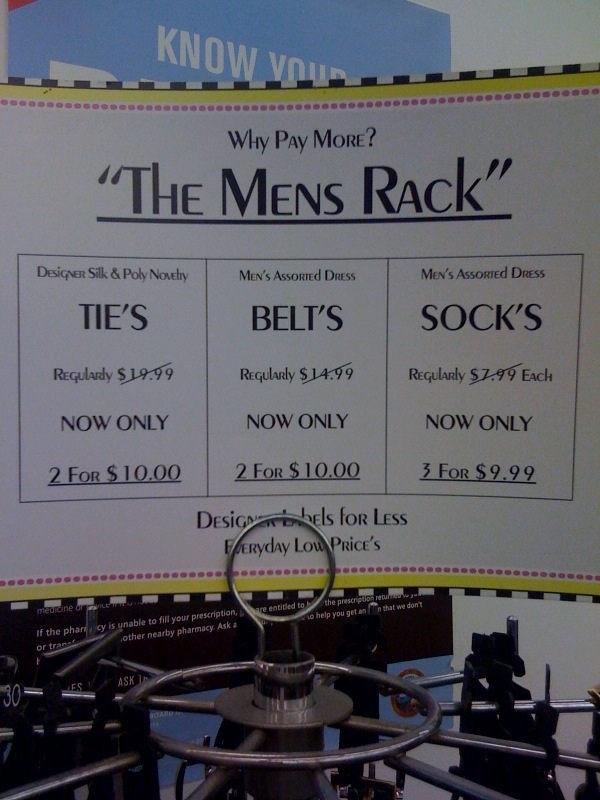
Apostrophes gone wild! — 06/07/2010
Don’t overload your sentences with negatives — 05/24/2010

Don’t overload your sentences with negatives

You’ve probably read news articles that started like this: The Supreme Court today overturned a lower-court ruling that held unconstitutional a law ending the ban on trans-fats in restaurant food.

What a mess. Few readers will understand after reading that sentence whether the Court ruled in favor of trans-fats or against them. I’m still not sure what the statement says exactly—and I wrote it!

You actually have to map out a sentence like this, starting from the end. First, a law banned trans-fats in restaurants. Then another law ended that ban. Then a higher court undid that law. And on and on it goes. Don’t do this to your reader.

Some work-related documents are written this way:

HR is ending the practice of allowing department heads to stop project leaders from approving comp time for employees working unpaid overtime.

Re-word the statement to make it clear:

Several department heads have overturned comp time for employees who work unpaid overtime. HR is ending this practice and starting a new policy that grants project leaders the authority to approve comp time for their employees who work unpaid overtime.