Words Matter

Advice on Communicating (Learned the Hard Way)

Some great ideas for making yourself more charismatic — 12/30/2010

Some great ideas for making yourself more charismatic

The dictionary defines charisma as “a rare personal quality attributed to leaders who arouse devotion and enthusiasm.” Also: “personal magnetism or charm.”

Sounds like a skill worth developing if you can, yes?

I just heard a great lecture about charisma. (Wish I could remember the speaker’s name, so I could give him full credit.) Among the insights was this list of key conversational tools, which when taken together will help you build your level of charisma. I found them worth remembering; hope you find them useful too.

  • Don’t complain unless it’s for a productive reason
  • Try to use the same speed and tone of voice as your fellow communicator
  • Focus less on yourself in conversation and more on the other person
  • Don’t look down when you’re walking
  • Look people in the eye
  • Smile more often
Just thinking out loud — 12/27/2010

Just thinking out loud

I never really understood Einstein’s theories about time being warped just like space… until I realized that IT’S ALMOST 2011 ALREADY!

Is it just me, or did 2010 go by in 6 months?

Just asking… — 12/25/2010
A radical idea for better meetings — 12/08/2010

A radical idea for better meetings

Want more efficient and productive meetings? Don’t allow laptops or cell phones.

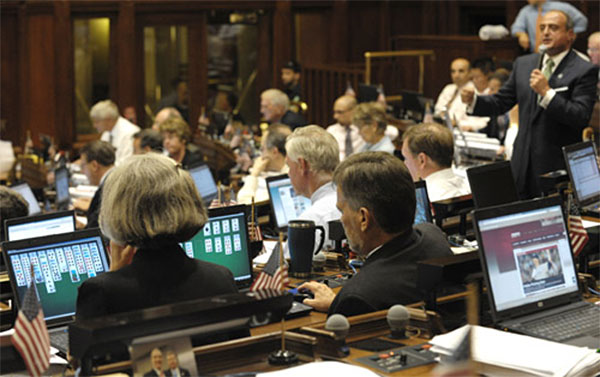
Here’s the Connecticut state legislature in session. As you can see, at least a few of these legislators are playing solitaire. One lawmaker is checking out sports news. And those are just the laptop screens we can see! Who knows how many of the other legislators in this photo are goofing off on their computers when they’re supposed to be working?

When people bring laptops and phones into your meetings, they’re bringing in their entire social and professional worlds — games, news, email, Facebook (“… in a meeting and wishing I weren’t!”), etc. That’s just too many distractions.

Think of it this way. If you invite your entire team of, say, seven employees in for a one-hour meeting — and the meeting turns out to be completely unproductive — how much time have you wasted? Most people think it’s one hour. But actually, it’s eight or nine hours — an hour for each employee, plus an hour of your time for attending and maybe another hour or so in preparation for the meeting.

That’s a lot of your staff’s time, a lot of your organization’s time. You’re essentially making a decision when you gather all those folks in a room that your meeting is worth more to your team and organization than anything else your entire staff could be working on if they weren’t in that meeting. And the only way to make your meetings that productive and valuable is to make sure everyone is truly present. Limit distractions.

Now, if you need a computer in the room to research things that come up in discussion, fine. Designate someone to have a computer.

But your rule should be: Bring paper and pen – and your undivided attention.

What PowerPoint is not — 11/19/2010

What PowerPoint is not

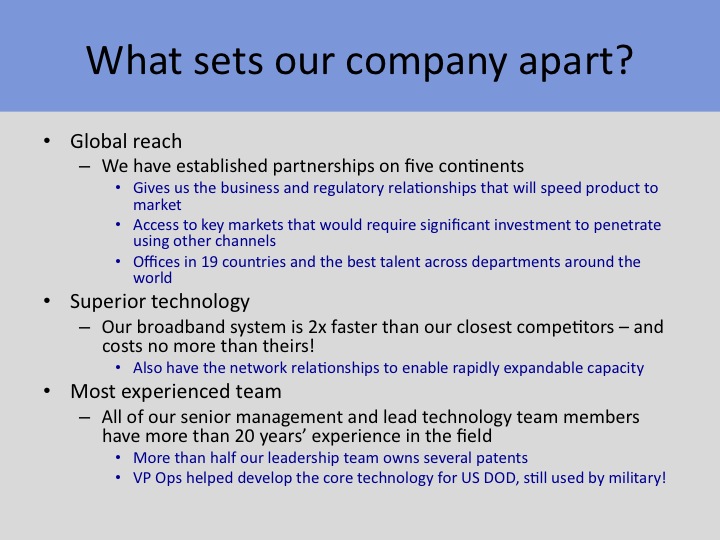
Example of Bad PowerPoint

PowerPoint is not a document. It’s not a series of virtual notecards projected onto a screen for you to read aloud, either.

A PowerPoint presentation is a visual supplement to your talk or meeting — that’s it.

If you need this many words on a slide, you’re better off creating a Word document and sending it to the folks you’d otherwise invite to your meeting.

Trust me — they’ll thank you.

Free report: how to write effective emails — 10/28/2010
Use “mode matching” to connect with people — 10/25/2010

Use “mode matching” to connect with people

People tend to experience the world primarily through one of the five senses: sight, sound, touch, smell or taste. People also tend to communicate using the sense they’re most comfortable with. Knowing which sense most resonates with someone can greatly enhance your ability to connect with that person.

Visual people: “I see what you mean.”

Auditory people: “Sounds good to me.”

Get into the habit of listening for these types of clues in your conversations, to determine how the people you speak with regularly experience their world. Using the same sense they do—called mode matching—will build a deeper connection and get your messages across more clearly.

Talking with a visual person:

When someone says, “Let me show you what I think we should do…”

Your answer should be something like, “Looks good to me,” or, “We definitely see eye-to-eye on this.”

Talking with a tactile (touch-oriented) person:

If someone says, “I can’t seem to put my finger on the problem…”

You might answer, “Let’s lay it out again and see if we can get our arms around it.”

When you mode match, you make the conversation richer and more memorable for the other person, because you’re speaking in a vocabulary comfortable to them. They’ll probably have no idea why they feel the connection, but the conversation will go much more smoothly.

The opposite is also true: When you don’t mode match, you can leave the other person feeling frustrated, or like they’re not being understood—and you’ll have a much harder time getting your own message across.

Down a bunny slope? — 10/11/2010

Down a bunny slope?

On a conference call recently, one of my colleagues said she was worried we were “going down a bunny slope.”

I’m pretty sure she meant going down a rathole, meaning losing our focus and veering into a discussion that would only waste time. And if that’s what she meant (although who can know for sure?) then she was right.

But here’s reason five gazillion to watch your clichés and corporate-speak. If you get the phrase wrong… youch. “Bunny slope?”

Three things most public speakers forget — 09/12/2010
Think hard before you put anything in email — 08/24/2010

Think hard before you put anything in email

Just a few examples of how writing the wrong things in an email can do significant, irreparable damage:

It cost Governor Mark Sanford his job and good name.

Mark Sanford, the disgraced former governor of South Carolina, was ultimately ousted from his position because of an extramarital affair. The evidence that proved the affair – and made Sanford an international laughing stock – was a series of emails he wrote to his mistress.

A short excerpt: “I could digress and say that you have the ability to give magnificent little kisses, or that I love your tan lines or that I love the curve of your hips….”

Think the governor expected to find this private email to his mistress published in newspapers around the world?

It cost one of the most respected climate research facilities its credibility.

The Climate Research Unit at England’s University of East Anglia is one of a handful of research centers from which the United Nations pulls data for its global climate reports. The head of the Climate Research Unit, Phil Jones, became the subject of worldwide suspicion and criticism when emails surfaced showing that Jones had manipulated climate data. Emails like this:

“I’ve just completed Mike’s [science journal] Nature trick of adding in the real temps to each series for the last 20 years and from 1961 for Keith’s to hide the decline.”

Now that these emails are public, do you think the public will ever again trust Phil Jones’s climate analysis?

It cost Cerner Corporation and its shareholders millions of dollars.

In 2001, Neal Patterson, CEO of the healthcare IT company Cerner Corporation, sent an internal email to his senior staff, berating them for not working hard enough – and threatening to fire them all.

An excerpt: “As managers, you either do not know what your EMPLOYEES are doing or you do not CARE. In either case, you have a problem and you will fix it or I will replace you.”

The email leaked. Investors got nervous. And the company’s stock dropped nearly 22%.

———————

You never know where your email will surface, who will read it, or how it will be used. So when you’re writing any email message – even an informal one to a trusted friend – remember this rule: If you wouldn’t say it to the whole group in a staff meeting, don’t write it.